Here are a few options: you can invest through this broker, that platform, or your demat account; you may need to compare yields and lock-in periods yourself.
With Silver Suits AI
Just say it, and every tax-saving bond you’re eligible for shows up right there, ready to invest.
You know what you want to do. Finding the right place to do it is taking the effort. What changes when the journey starts with a request?
Silver Suits AI5 min read
You can make a payment without thinking much about it. Open the app, choose the recipient, enter the amount, confirm.
Then you try to change a card setting you haven’t touched in months.
Where was it again? Cards? Services? Manage Account?
You open one menu, go back, and try another. You know what you want to do. Finding the right place to do it is taking the effort.
Years of using the internet don’t necessarily prepare you for this moment. You can be comfortable shopping online, booking travel, and managing work on your phone, yet still struggle to find an unfamiliar feature in your banking app.
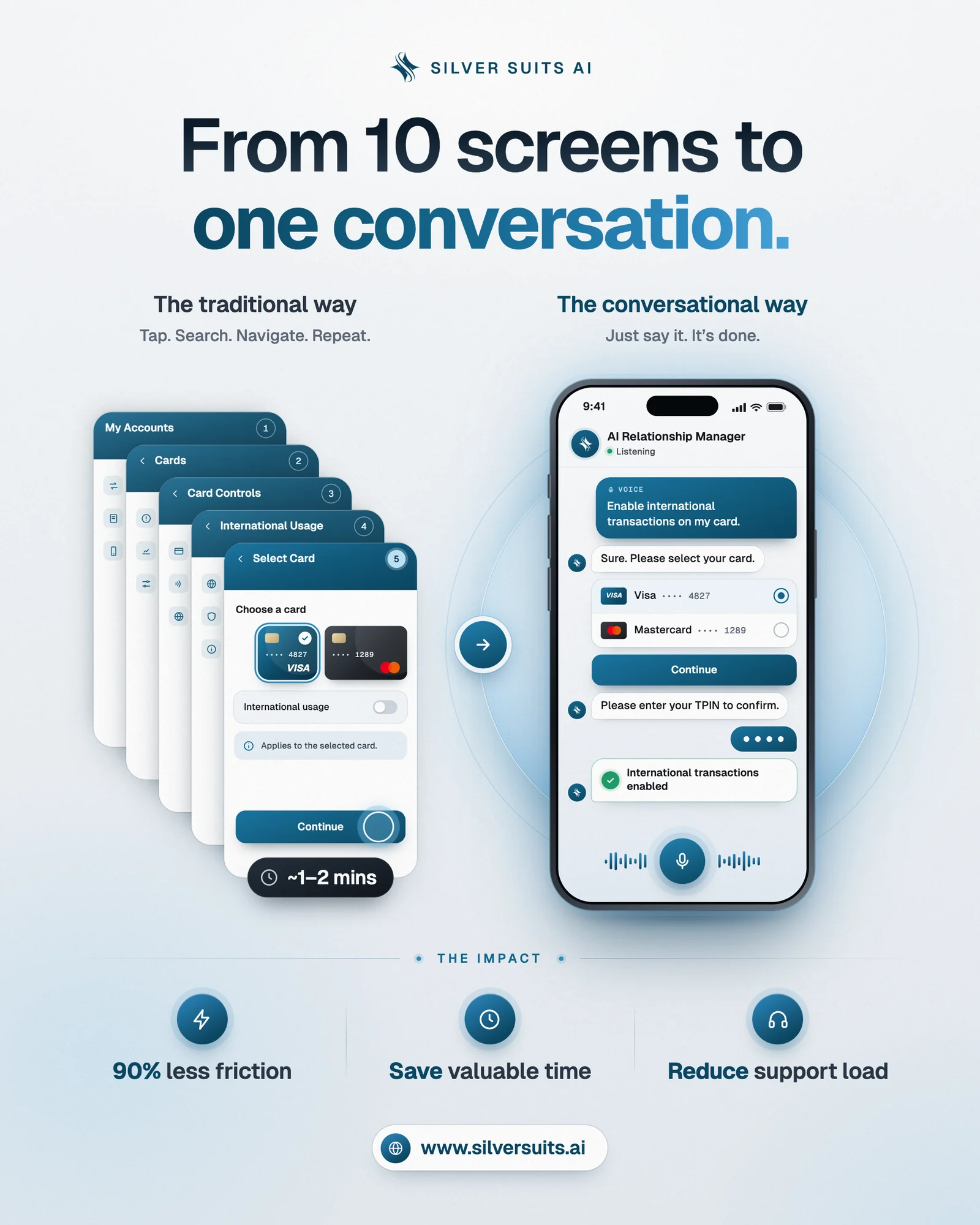
The problem becomes clear in one simple request:
“I just want to enable international transactions on my card. Why is it so hard to find?”
For banks, that question reaches beyond interface design. It touches the value of the digital experience itself. A service available inside an app delivers its value when customers can find it, understand it, and complete the task they came for.
01The features are there. Finding the right one takes work.
Banking apps have a lot to accommodate.
Customers need payments, statements, card controls, deposits, service requests, and access to different financial products. Different customers need different combinations of those services.
Organizing that functionality is a substantial design challenge. A menu structure that makes sense to someone who works with the application every day may be unfamiliar to someone who visits a particular screen once a year.
Frequent tasks become familiar through repetition. You remember how to check your balance because you do it regularly. You know the payment flow because you have followed it before.
An occasional task is different. You may need to change a transaction limit, manage a mandate, or update a preference without knowing the terminology the app uses.
You think, “I need to use my card abroad.”
The app presents categories such as “Card Controls,” “Usage Preferences,” or “International Usage.”
Somewhere between your intention and those labels, you have to work out the route.
Better navigation helps. Clearer language helps. But there is another possibility: letting customers begin with what they want to do.
02An unfinished digital journey can become someone else’s work. Hello, BPO costs.
Consider what might happen when a customer cannot find that setting.
They search the help section. Perhaps they open a chat. They may call customer support and ask someone to guide them through the app.
The feature was already available digitally. Completing it still required assistance.
That distinction matters when assessing the value of self-service.
Building an app takes significant work. Maintaining its services, integrations, and controls takes more. The return on that effort depends partly on whether customers can use those services successfully.
A feature’s presence tells you what the app offers. Completed tasks tell you whether people can make use of it.
When customers can finish appropriate tasks independently, banks have an opportunity to reduce avoidable support demand. Human teams can spend more time on requests that need investigation, judgment, or personal attention.
The size of that benefit needs to be measured. It will depend on the workflow, customer adoption, reliability, and the cost of operating the solution. Adding an AI assistant does not, by itself, establish a saving.
The starting point is a specific problem: a task customers could complete digitally, but need help finding or following.
03What if the journey started with a request?
Imagine opening your banking app and saying:
“Enable international transactions on my card.”
The app now has a description of your goal. With the relevant workflow integrated, a conversational assistant can help you reach the appropriate controls and provide the information needed to continue.
If you have multiple cards, it can ask you to select one. If the request leaves an important detail unclear, it can ask a focused question. Before the change is submitted, you can review what is about to happen.
This is the idea behind a banking concierge within the application: help that connects a customer’s request to the steps required to carry it out.
Silver Suits AI’s in-app assistance is designed around that connection, bringing voice navigation, form assistance, and commands into supported application journeys.
The useful part is what happens after the conversation begins. The assistant needs to help the customer progress through the task while making the choices, required approvals, and outcome clear.
04A helpful assistant needs to handle the difficult (contextual) moments
Real requests rarely arrive in one perfectly worded form.
Someone might say, “I want to use this card overseas.” Another customer might ask to “change international settings.” A person could change their mind about the card halfway through the interaction.
The assistant needs to recognize when it has enough information and when it needs to ask.
A short clarification can prevent a much larger misunderstanding. Displaying a choice may be more useful than asking the customer to repeat a long explanation.
There will also be situations where the task cannot finish. A service may be unavailable, the account may not permit the requested action, or the system may return an uncertain status.
In those moments, the customer needs to know what happened, what remains incomplete, and how to continue.
A conventional screen or human support route should remain available where needed. The purpose of conversational assistance is to help people complete their work, including when the conversation itself cannot resolve it.
05What this means for the bank
For a banking team, the opportunity extends beyond a more approachable interface.
Helping customers complete supported tasks can improve the usefulness of services the bank has already built. It may also reduce contacts made simply to locate a feature or understand the next step.
Those outcomes deserve a focused evaluation.
Measure successful completion. Did the customer finish the intended task correctly? Opening the relevant screen is useful progress, but it is different from completing the change.
Look at where customers need to correct the assistant. Repeated requests, wrong selections, and unclear questions reveal where the experience needs work.
Check the need for additional help. Did customers still contact support about the same task? If so, what remained confusing or unresolved?
Include exceptions in testing. Ambiguous requests, interrupted sessions, and failed actions are part of the workflow. Test whether customers receive accurate information and a usable next step.
Assess the complete operating cost. Any savings calculation should include integration, platform usage, maintenance, monitoring, and human handling of unresolved requests.
This gives the bank a practical basis for deciding whether to expand the experience. It also keeps the business case tied to customer outcomes rather than the appeal of a demonstration.
06Start with a task customers already want to complete
A first conversational journey does not need to cover the whole application.
Choose a task with a clear purpose, an identifiable outcome, and a way to verify completion. Understand where customers struggle today. Then examine whether conversational assistance helps them move through it with less confusion and appropriate control.
The card-setting example is compelling because the customer’s intention is easy to recognize. They want to use a service the bank already provides. The difficulty lies in getting from that intention to the right action.
That is a useful place to focus product design.
Customers will continue to need the features, processes, and safeguards behind their banking services. They should also have help reaching and using them.
Explore Silver Suits AI to discuss how conversational assistance could support a specific journey in your banking application.

 With Silver Suits AI